
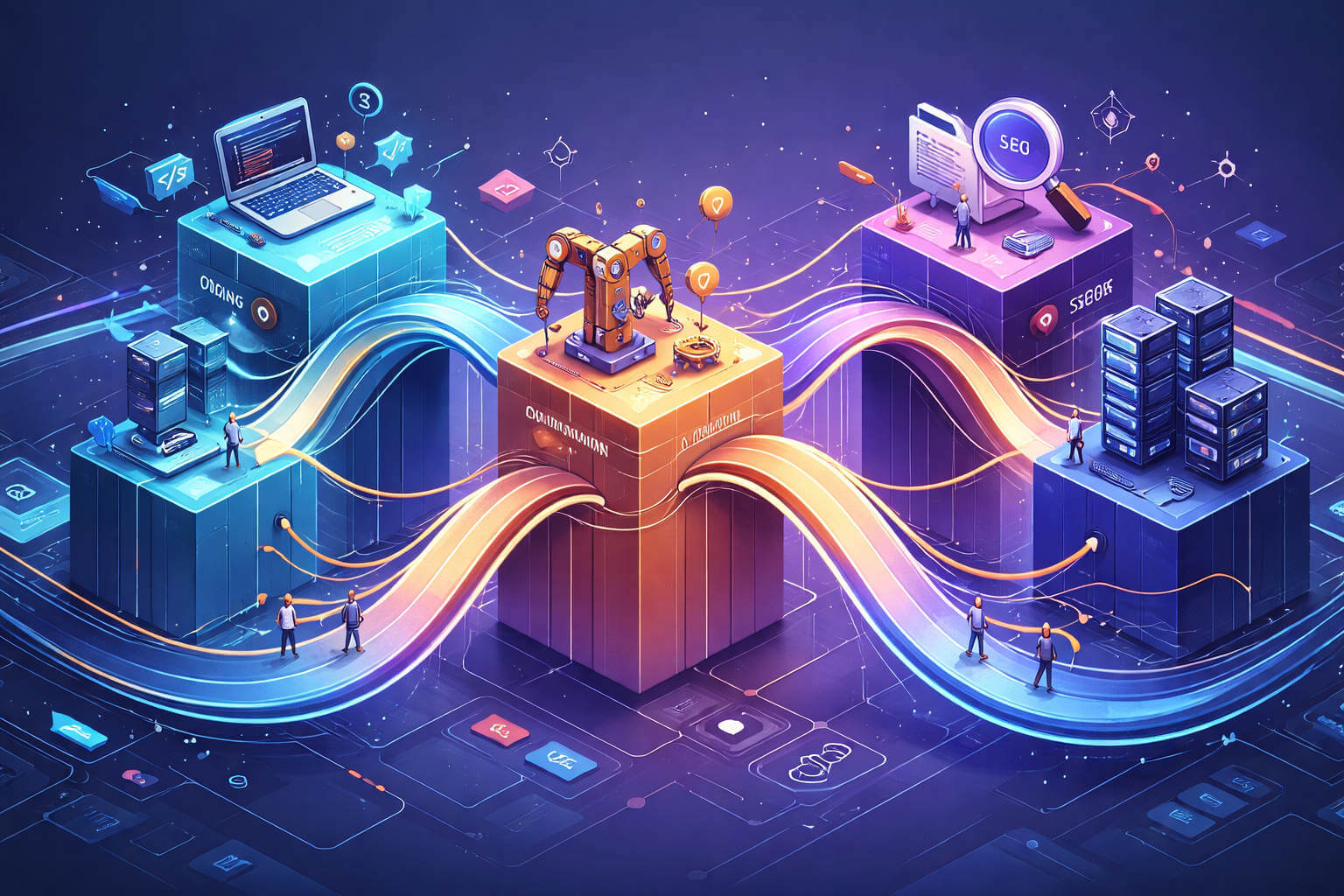
There’s a question I hate.
“What’s your favorite color?”
Or worse: “Who’s your favorite artist?”
I know it’s an innocent question, a simple attempt at small talk. But every time, I freeze. Because answering “blue,” what would that even mean? That I don’t like red? That orange doesn’t count?
To me, it’s like someone saying: “It’s the end of the world, you can only listen to one song on repeat for the rest of your life, which one is it?” Well… there isn’t just one. There are ten, twenty, depending on my mood, the context, the time of day. Forcing me to choose just one is mutilating all other possibilities.
And when I look at the details of my personal and professional life, I realize it’s pretty much the same.
If I take stock of recent years, I see a real pile of more or less abandoned projects. A camera collecting dust. Half-finished n8n workflows. A VPS with services I set up, tested, then abandoned for something else. Courses started. Programming languages learned then neglected.
For a long time, I was ashamed of it. Because society has a word for that: dilettante. And I kept telling myself: “You’re chaotic, you lack determination, you can’t stick to anything, you start everything without ever really finishing anything.” In short, like many people, I felt like an impostor with this question spinning in my head: “So what exactly do you do?”
But recently, I came across a concept that completely changed how I see things. What if this chaos wasn’t a flaw, but a survival strategy? What if my inability to choose “just one thing” was precisely what made me adaptable and effective in the things I undertake?
The lie of hyperspecialization
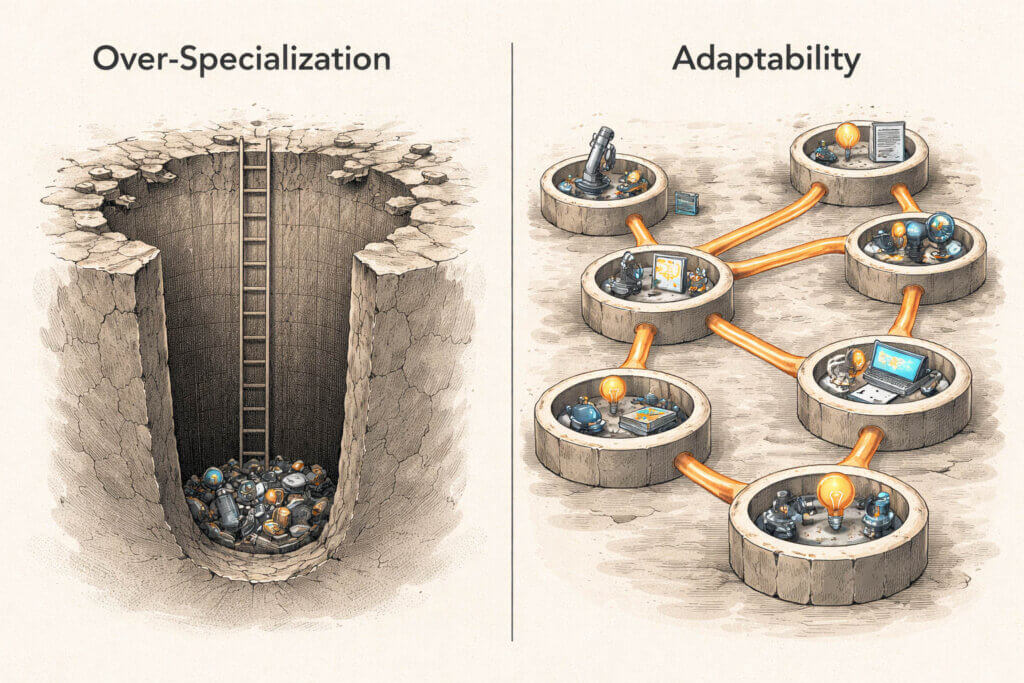
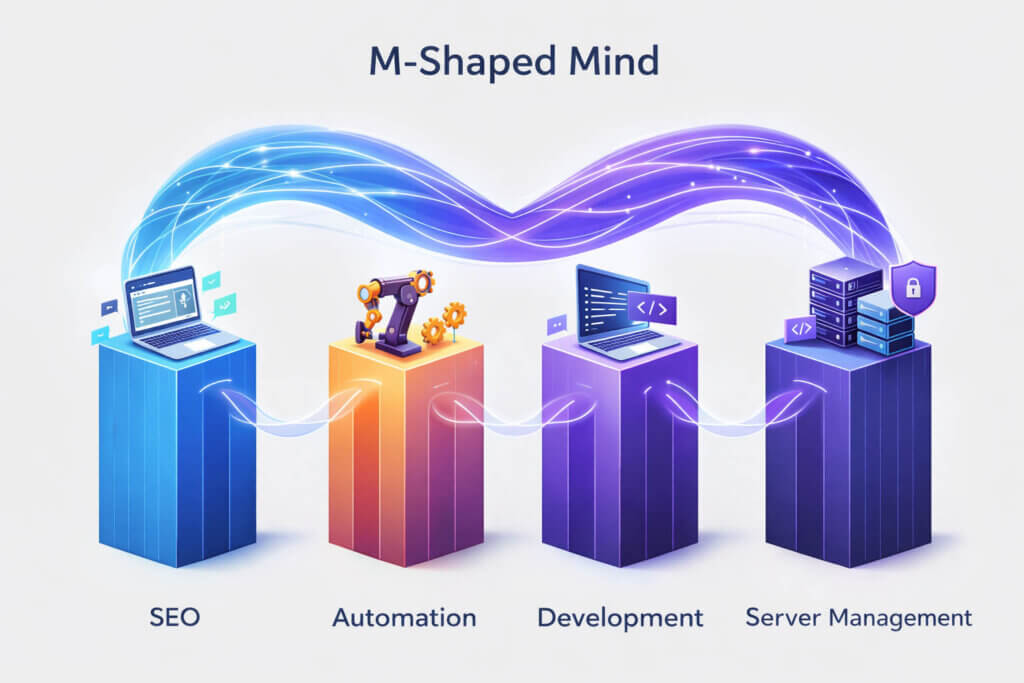
Throughout the 20th century, the working world valued only one type of profile: the specialist. The one who digs a mile-deep hole in their field. The sharp expert. The T-shaped profile: general knowledge, but an ultra-developed specialty.
Except here’s the thing: we no longer live in a stable environment. Industries change every 5 years. The tools you master today are obsolete tomorrow. The clients you work with evolve, their needs transform.
In this context, the specialist is fragile. If their industry collapses, they become obsolete overnight. Me, with my SEO background, I’ve seen link building experts lose all their value the day Google released Penguin. Keyword stuffing pros made useless by an algorithm update.
My brain, instinctively, always knew this. That’s why I drift. Why I move from automation to workflows, then to server security, then to AI integration, then to content strategy. Not from lack of focus, but from adaptation and instinct.
The M-shaped mind (and why I’m not T-shaped)
I learned that in cognitive psychology, there’s a concept called the M-shaped mind. Unlike the T-shaped profile (generalist with a specialty), the M-shaped profile has multiple pillars of depth connected by a bridge of curiosity.
Concretely, what does that mean for me?
I’m not just SEO. I am:
- SEO with expertise in thematic architecture
- WordPress developer (with a preference for GeneratePress and automations)
- n8n specialist for creating automation workflows
- Self-hosting and server security enthusiast
- API integrator (DataForSEO, Claude, Replicate…)
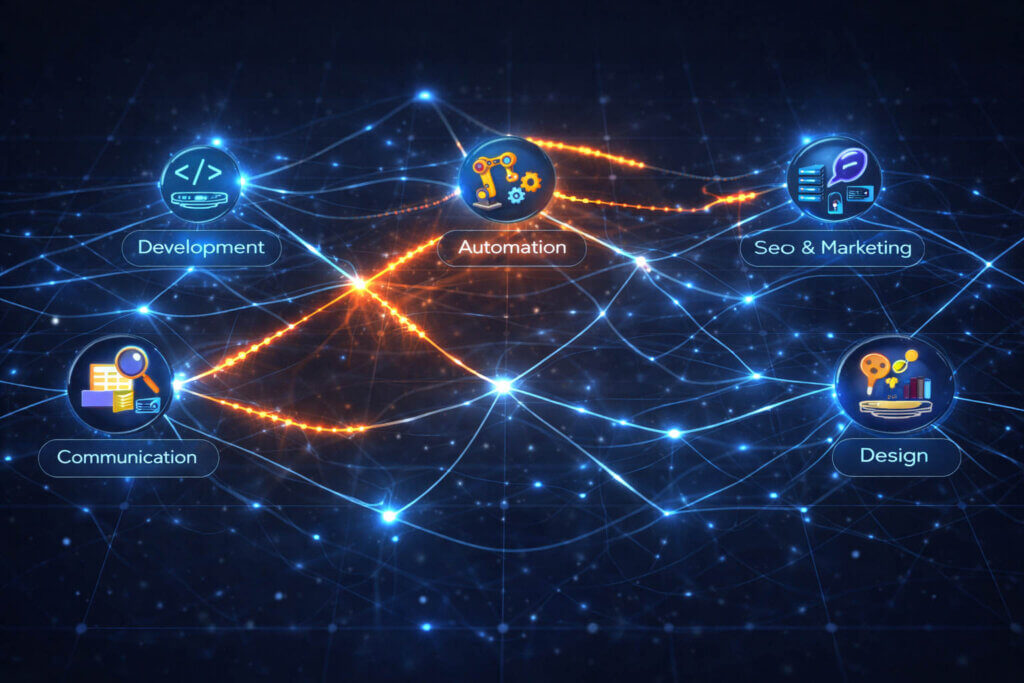
These skills aren’t randomly scattered. They feed each other. My SEO expertise pushed me toward automation. Automation forced me to understand APIs. APIs led me to manage my own servers. And all of this together allows me to offer solutions that nobody else provides.
This is what’s called far transfer: taking a concept from a completely different domain and applying it to another. Not just solving the same problems with the same tools, but creating innovative solutions by crossing universes that never talk to each other.
My system for not doing everything at once
Except… understanding all this doesn’t solve the immediate problem: burnout.
Because yes, having 15 projects in progress is exhausting. Always feeling like you’re at the starting line, never an absolute expert, weighs heavy. Seeing highly specialized people crushing it in their niche while you flutter around makes you doubt.
The solution I found? See my life in seasons.
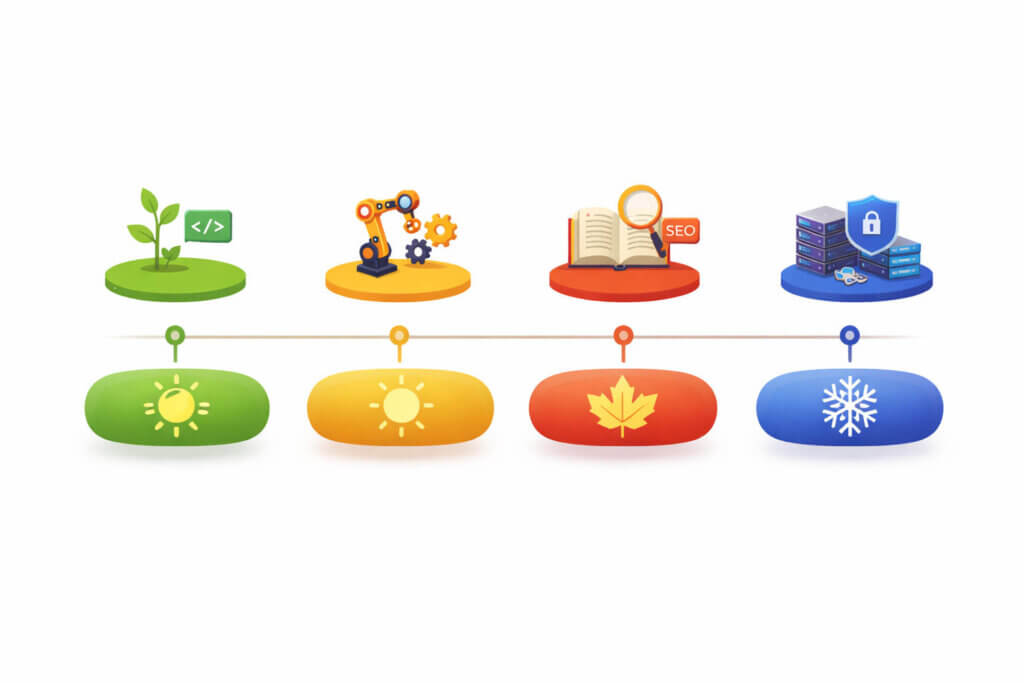
I can’t do everything at once. But I can do multiple things in sequence, giving each their moment in the spotlight. For example:
- Q4 2024: major focus on n8n workflows and Claude API integration to automate SEO briefs
- Q1 2025: client site migrations, content architecture, thematic clusters
- Q2: maybe I’ll seriously get back into Docker and containers, I don’t know yet
The idea is not to apologize for changing focus. But to accept that each skill has its season. And that all will eventually converge in projects that wouldn’t exist without this diversity.
“Redundancy” as life insurance
According to evolutionary biology, redundancy isn’t waste, it’s strength.
Elephants have massive genetic redundancy that protects them against cancer. Redundant computer systems never completely fail. And me, with my multiple skills, I’m anti-fragile.
If tomorrow SEO disappears (extreme hypothesis, but still), I can pivot to WordPress dev. If WordPress dies, I master automation. If automation becomes obsolete, I have my skills in content strategy, self-hosting, AI integration, etc.
Each skill is a safety net, not a distraction.
The tyranny of the “favorite”
There’s something that fascinates me about society’s obsession with unique choices.
Your favorite movie? Your main passion? Your preferred expertise? Your favorite dessert? Your signature song?
As if life were a checklist, and you absolutely had to fill in only one box per category. As if being human meant being an Ikea questionnaire where every answer must be binary.
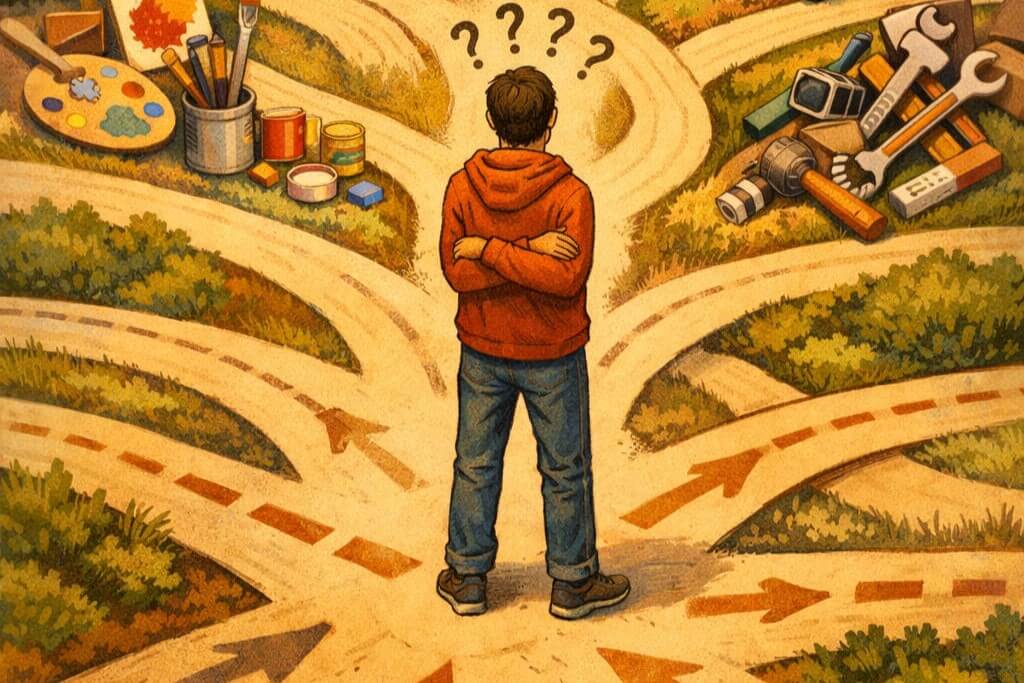
When asked my favorite color, I can’t answer. Not because I’m indecisive. But because the blue I love for a winter sky has nothing to do with the orange of a sunset or the green of a spring forest. Choosing one over the others makes no sense to me.
And it’s the same for my skills.
“So what are you, SEO or developer?” Both, sir, but also “automation specialist” and content strategist and server configuration enthusiast and IT geek constantly testing new tech, etc.
“Yes but what do you specialize in?” Well, nothing or everything, depends on the project.
Some time ago, during a workshop in Andorra, Laurent Bourrelly (French SEO expert, inventor of the semantic cocoon and local generative AI specialist) said something that struck me. Talking about me, he said: “Gregory’s strength is precisely that you can talk about anything with him. He knows a tremendous amount about many different subjects. That’s his great strength: he can adapt very easily.”
At the time, I almost wanted to apologize. As if knowing “a lot about many subjects” was less legitimate than knowing “everything about one subject.” But thinking back, I realized that was exactly it, my value. Thanks Laurent for your frank and honest feedback.
This inability to check just one box isn’t a bug. It’s precisely what allows me to build solutions that nobody else offers. Because nobody else crosses these domains, and I love that.
The world wants me to choose between SEO or automation. I do both at the same time, and it produces workflows my clients would have never imagined possible.
Making peace with my unfinished projects
So yes, I have cameras collecting dust. And a blog with unpublished articles. And Docker projects I abandoned at 60%. And no, I still can’t tell you what my favorite song is, nor my favorite color, nor my favorite programming language.
But I refuse to apologize for that.
Because each project, even unfinished, was a semester in the university of my own creation. Because I’m not a fragile specialist, I feel more like a bridge between worlds and universes. And because in a hostile environment that constantly changes, my ability to drift is my greatest strength.
If you too feel scattered, if people reproach you for never finishing what you start, if you feel like an impostor because you’re not an “expert” in anything, if someone asks you “what’s your thing” and you freeze because there isn’t just one… maybe you’re not chaotic. Maybe you’re just building your M-shaped mind.
And that’s a superpower.